


Most young men today drift into adulthood without a map. No real plan, a generic education that doesn’t really prepare them for anything, and no understanding of what they want to achieve, or how to achieve it.
Centuries ago, the craft guilds of medieval Europe offered something clearer. A structured path that turned ordinary boys into skilled, confident men who could support families and contribute to society. This article looks at how that system worked - and what it can still teach us about helping young men succeed today.
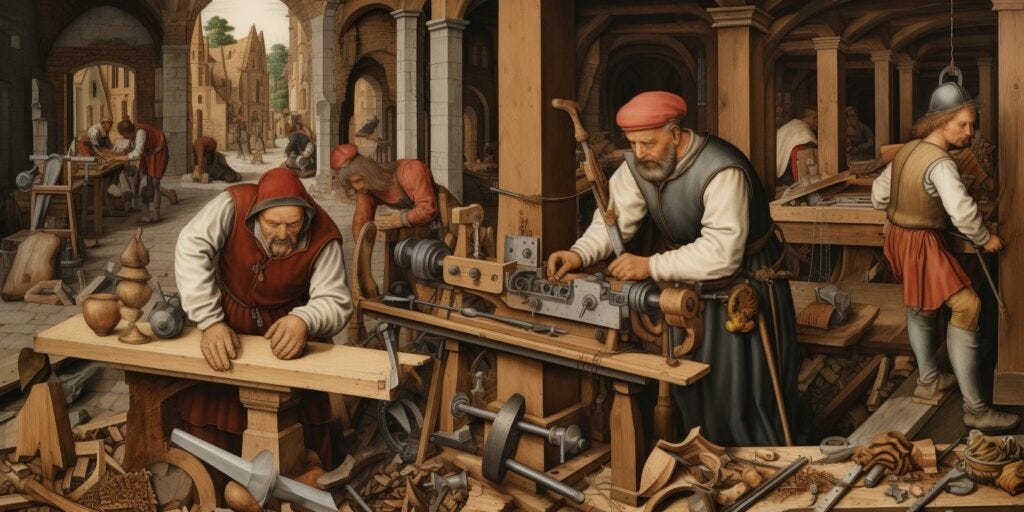
A boy of twelve or thirteen left home with little more than an indenture and entered a master’s workshop. He would spend years living under that roof, eating at the master’s table, working from dawn to dusk, and learning both the craft and the habits required to practise it well. The path was neither gentle nor optional for many, but at the time, it was the ordinary route by which boys became men of substance.
Guilds existed primarily to protect their trades, maintain quality, and train the next generation. In the process, they built one of the most effective systems for turning boys into productive men.
Every craft guild was built on the same hierarchy: apprentice, journeyman, and master. A boy entered at the bottom and climbed if he had what it took.
Apprenticeship usually began in the early teens and lasted five to nine years, sometimes longer depending on the trade. The boy lived in the master’s household. In return for room, board, clothing, and training, he gave his labour. The contract was binding, and runaways were returned. The master was expected to teach the full craft without holding anything back, and in many places also became something of a father figure. But the Guilds often required that a prospective apprentice already show good character.
The Cordwainers of London in 1271 insisted a boy be “of good character and decent behaviour, tractable, mild and complacent.”
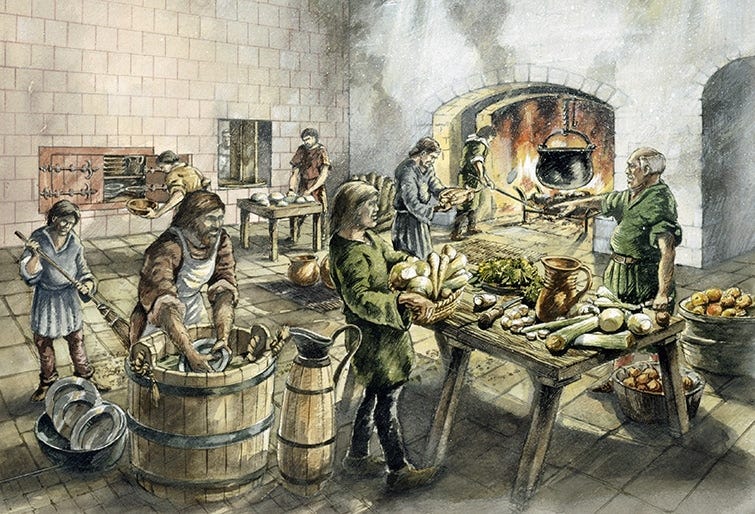
Once accepted, he was informed of the rules and sworn in. He learned to wake early, work carefully, respect materials, and what it is to have pride in producing something of worth. The workshop itself became a school of character.
After completing his term, the young man became a journeyman - the word from the French journée, a day’s work/travel. He could now earn wages and often travelled, working for different masters and learning different regional methods. This taught him how to be independent. A man who could find work in a strange town and deliver reliable results had proved more than technical skill. He had proved he could stand on his own.
Mastery required more. The journeyman must produce a masterpiece - a finished piece demonstrating full command of the craft - and submit it for judgment by the existing masters. He also needed the means to open a workshop. If accepted, he could take apprentices of his own, employ journeymen, and be involved in the governance of the guild. Masters regulated standards, settled disputes, and provided mutual support when members fell ill or died. The guild hall was the centre of a brotherhood that combined economic interest with social and religious life under a patron saint.
The system bound skill to character and individual effort to collective reputation. Poor work or bad treatment of apprentices damaged the whole guild. Benjamin Franklin, who served his own apprenticeship in the printing trade, once said:
“Remember that Time is Money. He that can earn Ten Shillings a Day by his Labour, and goes abroad, or sits idle one half of that Day… has really spent or rather thrown away Five Shillings besides.”
The guilds gave boys a visible road map to success. They also gave belonging. Members buried their dead, supported widows, and held one another to account. Isolation was rare. A man answered to men who knew both his work and his character.
That combination of competence, character, and belonging is precisely what many young men lack today. Any skills they learn are often useless in later life. Character is low on the list of priorities. Belonging is all too often to the wrong crowd. And young men are often left wondering aimlessly from job to job without a clear path ahead.
The Gentlemen’s Guild takes its name deliberately. Just as a medieval apprentice learned under a master and among others on the same path, men today need a place where guidance is given and received, competence is respected, effort is noticed, and where standards are pushed. The old guilds understood that a man rises more reliably when he is answerable to others who share his code, and that skill without character leaves him incomplete.
We do not need to recreate the fourteenth century. We do, however, need to recover some of the guild systems’ best principles: guidance from those further along, clear stages of progress, honest judgement of the work, and the company of men who will keep pushing you harder and further.
That is the mission of The Gentlemen’s Guild. We are building a living brotherhood where the same enduring principles are put into practice once more, where the masters can guide the apprentices.
The workshop may look different today, but the opportunity remains the same: to help men rise together.
We’re just getting started. If this interests you, then we would love for you to follow and subscribe.
Thank you
I mentor a lot of young men and women. If you ever want support in the Guild, let me know.
Before, I always considered my most important work raising my children. But now, it's all about teaching the next generation in my office and at my parish.
This is very insightful and motivated me to add to this for some thoughts I had while watching a Ronald Reagan movie.